
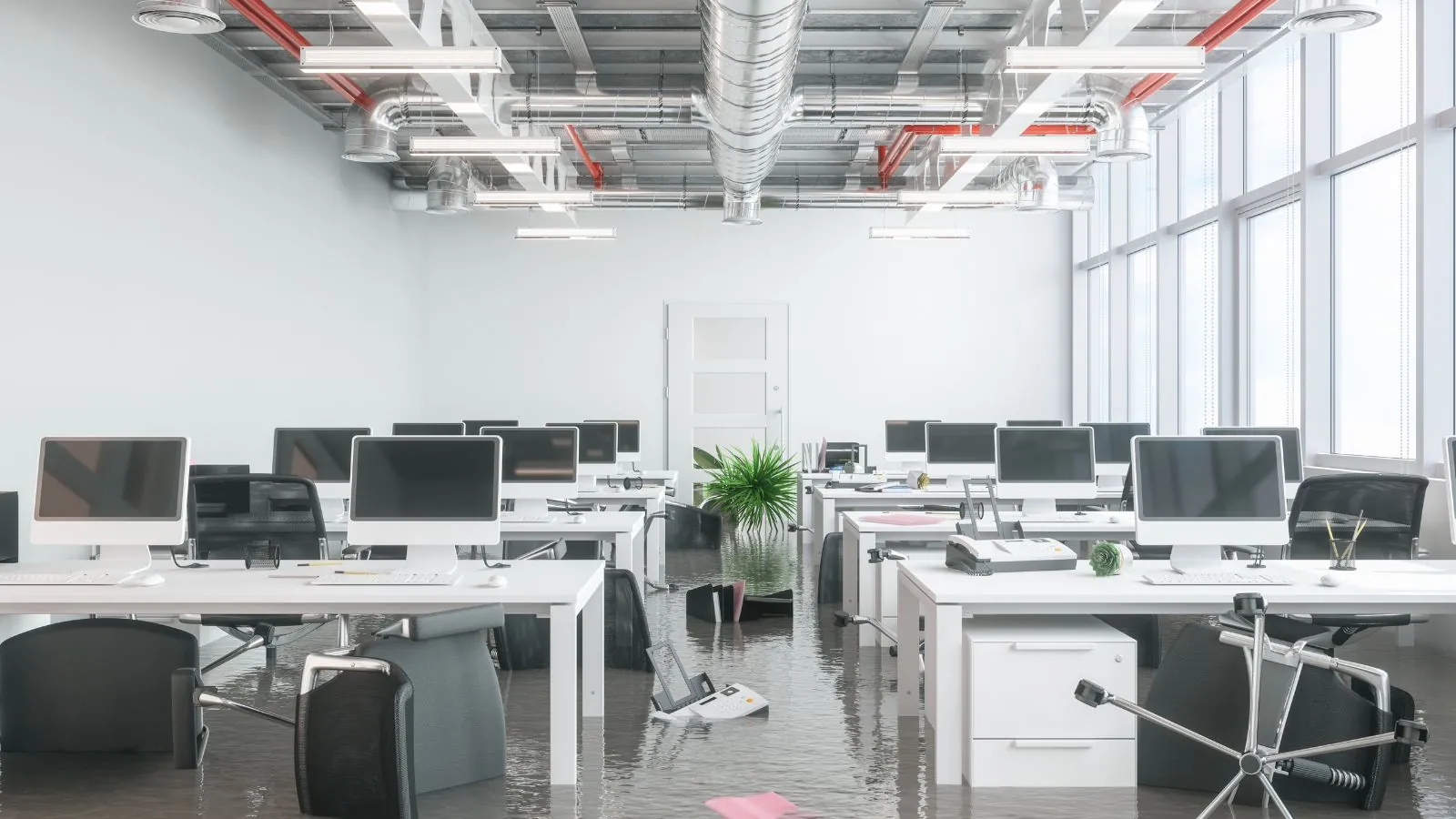
When commercial water damage is an emergency
A commercial water loss is an emergency because every wet hour can mean lost inventory, lost revenue and a building that cannot open. In Round Lake, IL the dispatch line is answered 24/7, and callers include shop owners, landlords, property managers and tenants.
Turn off the water at the main or the affected branch if you can reach it safely. Move inventory and records out of wet areas, shut off power to the affected zone only from a dry panel and take photos. Tell the dispatcher the type of building, the size of the area and whether more than one tenant is affected.
How a commercial job differs
Commercial buildings have larger floor areas, shared walls and systems, and often a landlord and tenant to coordinate. A leak in one unit can reach another, and a roof or sprinkler failure can wet several areas at once. Documentation matters because the owner, tenant and insurers may all need the same record.
The crew maps moisture across the building, extracts standing water with larger equipment and sets up drying zones. The same methods used in a home apply, scaled to the area. See structural drying for how readings guide the work.
| Situation | Key question | First step |
|---|---|---|
| Retail or restaurant flood | Is inventory or food at risk? | Extraction and contents move |
| Office ceiling leak | Is it plumbing, HVAC or roof? | Trace source, protect equipment |
| Multi-unit building leak | Which units are affected? | Map moisture across units |
| Warehouse or industrial floor | Slab size and stored goods | Truck-mounted extraction |
Call and give the building type and area affected. The dispatcher will explain what to document.
Documentation and working with landlords and insurers
Keep a record of what was wet, when it was found and what was removed. Photos, moisture logs and a written scope help a landlord, tenant or adjuster understand the loss. If the building is leased, check who is responsible for the structure and who for contents, because the lease decides that.
Do not discard damaged inventory before the adjuster has seen it, according to Illinois Department of Insurance guidance on claims, unless it is a health hazard. Photograph first.
What changes the cost of commercial water restoration
The scope and price are explained before work starts.
Commercial property and business interruption coverage vary widely. Ask your insurer or broker what applies, and keep records of lost time as well as damage.
Planning around an open business
Many commercial losses happen in buildings that cannot close. A restaurant needs its kitchen, a retail shop needs its sales floor and an office needs its network. The scope can be planned in zones, so drying equipment starts in the wettest area and the rest of the space keeps operating where it is safe.
Tell the dispatcher about hours, deliveries and any areas that must stay clean or cold. Noise, power draw and walkways all matter in a commercial setting, and the crew can plan equipment around them. Ask about timing before work starts.
Records for the owner, the tenant and the insurer
A commercial file usually has several readers. The owner wants the structure documented, the tenant wants inventory and downtime recorded and each insurer wants a clear scope. A single set of photos, moisture logs and equipment records serves all three.
Ask for a daily log with dates, readings and equipment counts. If the building has a property manager, copy them on the notes. Keep invoices for emergency steps, because mitigation costs are often claimed, and check your lease for who handles which part.
Serving Round Lake and nearby
The same line covers Round Lake, Ingleside, Fox Lake, Antioch, Island Lake and Spring Grove. See the Antioch page for the Route 83 and 173 corridor.
Commercial water damage questions
Do you handle commercial water damage emergencies at night or on weekends in Round Lake?
Yes. The line is answered 24/7. Give the building type and the area affected.
Do you work around an open business?
The scope can be planned around operating hours where the work allows. Describe your situation to the dispatcher.
Who is responsible, the landlord or tenant?
The lease decides. Check it and tell your insurer.
What should I document?
Photos, dates, what was removed and moisture readings.
The line is answered around the clock. Describe what happened and what you can see.