
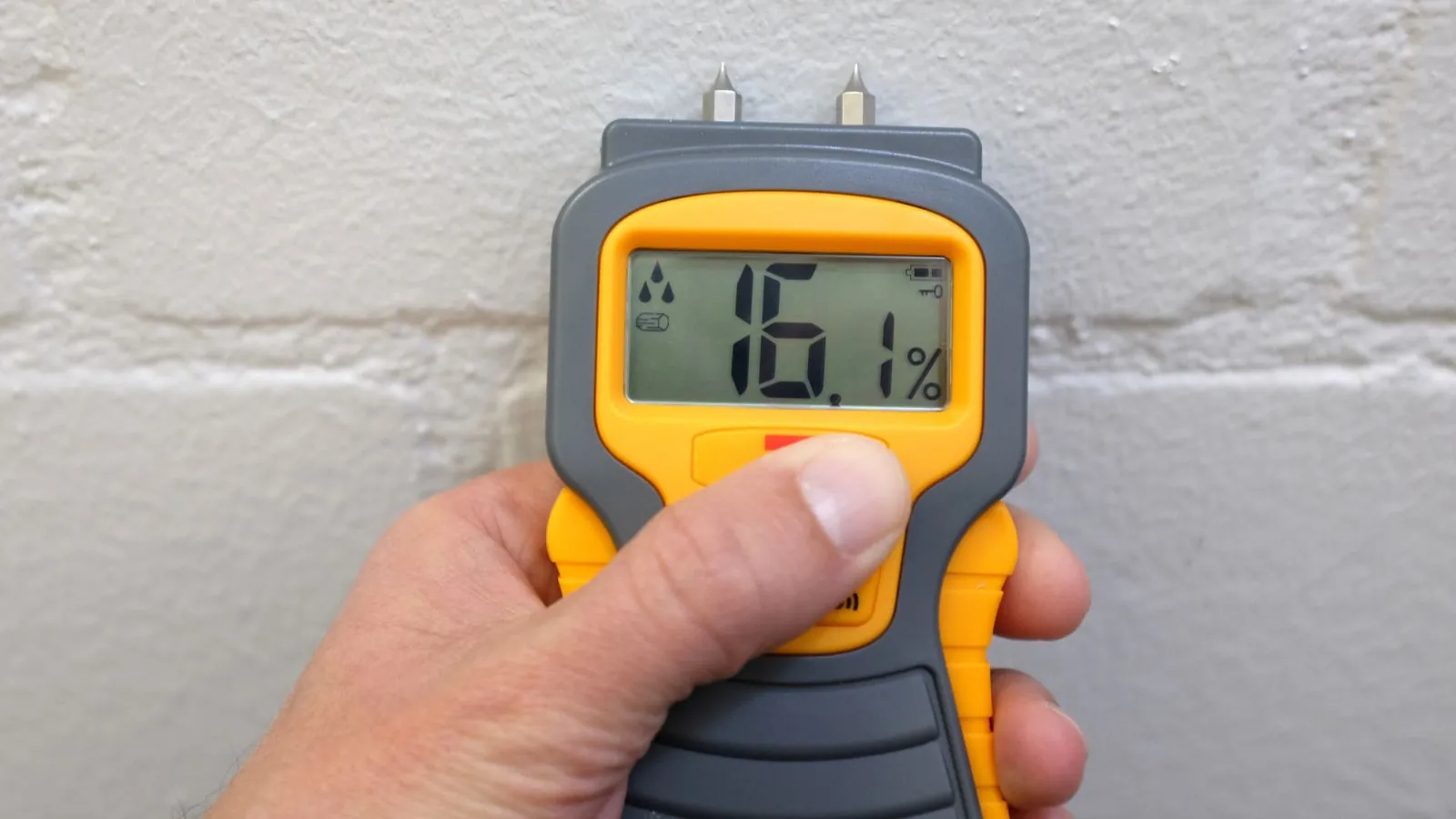
What moisture mapping is
Moisture mapping is a systematic set of readings taken across a building after a water loss. A crew walks the affected rooms with a moisture meter and records readings on floors, walls and ceilings, often marking them on a sketch of the floor plan. The map shows where the water is, how far it has spread and which materials are wet.
The map is repeated on later visits. As drying equipment runs, the readings fall, and the changes show whether drying is working. That is how a crew can say a structure is dry with numbers, not a guess.
The tools
Three tools do most of the work. A pin meter reads moisture content in wood and drywall by sending a small current between two pins. A pinless meter scans a surface without damaging it and reads moisture below the surface. A thermal imaging camera shows temperature differences, because evaporating water cools a surface, so wet areas often look different from dry ones.
A thermal image is not a moisture reading. It points to places to check, and the meter confirms. Used together, they find water in a wall cavity, under a floor or above a ceiling without tearing things open.
| Tool | What it reads | Limit |
|---|---|---|
| Pin meter | Moisture content in wood and drywall | Leaves small pin marks |
| Pinless meter | Moisture below a surface | Depends on material |
| Thermal imaging camera | Surface temperature differences | Not a direct moisture reading |
| Hygrometer | Air temperature and humidity | Reads the air, not the materials |
The dry standard
A moisture reading means nothing without a reference. Crews set a dry standard by taking readings in unaffected parts of the same home, such as a similar wall in a dry room. Wet materials are dried until their readings match that standard. This is the idea described in ANSI/IICRC S500, the published standard for water damage restoration.
It also means a reading is relative. A concrete slab reads differently from drywall, and old framing differs from new. The standard is set per material, and that is why a good crew explains it instead of quoting a single number.
What the map changes in practice
A moisture map decides where equipment goes, which materials stay and which come out. If a wall reads wet above the waterline, the crew may open it to dry the cavity. If a floor reads wet under the finish, the subfloor may need attention. And if readings stop falling, the map tells the crew to look for another source.
For you, it is a record. Ask for a copy. It shows your insurer what was wet and when it was dry, and it shows you why equipment stayed as long as it did. See structural drying and dehumidification for the equipment side.
How to use the map as a homeowner
Ask the crew to show the readings on your first visit and again at each check. Ask what the dry standard is and what the target is for each material. If a reading is not falling after a day or two, ask why. The answer might be a hidden leak, a wet cavity or equipment that needs to move.
If you smell must or see staining after the equipment is gone, ask for another set of readings. Hidden moisture shows up as a smell before it shows up as a stain, and the mold remediation page explains what follows when growth starts.
Mapping different materials
Different materials read differently, so a single number across a house is not meaningful. Drywall is read on a scale built for gypsum, wood on a scale for moisture content and concrete with specialized meters or relative humidity probes. A crew notes the material at each reading and compares it with the dry standard for that material.
Concrete is the hardest. It can look dry on top while holding water deeper in, and it dries slowly. That is why crews check slabs with more than one method and keep equipment longer when a slab is part of the loss.
Common mapping mistakes
A few errors cause trouble. Reading only at the surface misses water deeper inside a wall. Comparing readings without a dry reference leads to wrong conclusions, and using a meter on a material it is not calibrated for gives meaningless numbers. Stopping drying because a floor feels dry is the most common mistake of all.
A good crew explains how they take readings and what they compare them with. If you are told a structure is dry, ask to see the readings, the dry standard and where they were taken.
Using the map to plan repairs
A moisture map is also a repair plan. It shows which walls need to be opened, which flooring must be lifted and which rooms can stay in use. Contractors who rebuild can use the map to see what was removed and what was dried in place, and an adjuster can use it to check the scope.
Ask for the final map with the last set of readings. It is a record of the drying result and a useful document if you sell the home.
What to do before a moisture map is taken
These steps are general safety practice and apply before anyone arrives.
- Leave wet materials in place until they are photographed, since removal changes the map.
- Open doors and cabinets so the meter can reach the surfaces.
- Note which rooms smell damp or feel cool to the touch.
- Keep a record of the date and source of the water.
- Avoid running a heater to speed drying before the readings are taken.
What this means in Round Lake
Lake County's hazard report on the July 2017 storm described flash flooding and sewer backups after roughly 3.4 to 7.2 inches of rain over two days. After an event like that, many homes are wet at once, and equipment and crews are in demand. A clear moisture map is how a crew decides where equipment is needed most and when it can move to the next house.
Basements in lake-adjacent areas such as Fox Lake and Ingleside tend to be cool and damp, which slows drying. The map shows when a slow area has finally caught up.
Source type: Lake County hazard mitigation plan annual report and ANSI/IICRC S500
Questions from Round Lake homeowners
Can I check moisture myself with a hardware store meter?
It can give a rough idea in drywall, but readings depend on material and settings. A crew compares against a dry standard.
Does thermal imaging prove a wall is wet?
No. It shows temperature differences that point to moisture. A meter confirms.
How many visits does drying take?
It depends on materials. Readings are logged each visit until they match the dry standard.
The line is answered around the clock. Describe what happened and what you can see.